
"Get to Know Your Garage Door"
At Garage Door All-Stars we want to make sure you have the knowledge and proper tools at your disposal to communicate well with your service company! Understanding how your garage door works and the correct names for the components will go a long way to assisting you and your goal of getting your garage door up and running smoothly again. Below is a diagram of a standard garage door to familiarize yourself, along with all the parts and names. We have also included a brief description of what these parts do.
1. TORSION SPRING- provides lift when under tension. 2. TORSION TUBE- long tube the spring(s) slides onto. 3. CABLE DRUM- reels in the cable as the door elevates. 4. TORSION CABLES- set of two cables that connect to bottom of door to provide lift via the spring. 5. BEARING PLATES- three plates that hold the torsion tube in place and rotate. 6. HORIZONTAL TRACK- the upper portion of the track with a curved radius, serves as a guide to rollers. 7. VERTICAL TRACK- the straight piece of track that goes to the floor and guides the rollers. 8. ROLLERS- located on sides of the door, they allow door to travel smoothly. 9. PANELS- the face of the garage door, 7 ft door has 4 panels, 8 ft tall door has 5 panels. 10. JAMB BRACKETS- "L" shaped brackets that secure the track to the wall. 11. HINGES- #1, #2, and #3 hinges connect the panels together and allow the garage door to travel the track radius. 12. TOP FIXTURES- adjustable fixtures that hold the top rollers in place. 13. BOTTOM FIXTURES- bottom plate on each side that holds the bottom rollers AND the torsion cable snaps into the nub. 14. STRUT- horizontal support fastened across the inside of the panel to provide rigidity and support.
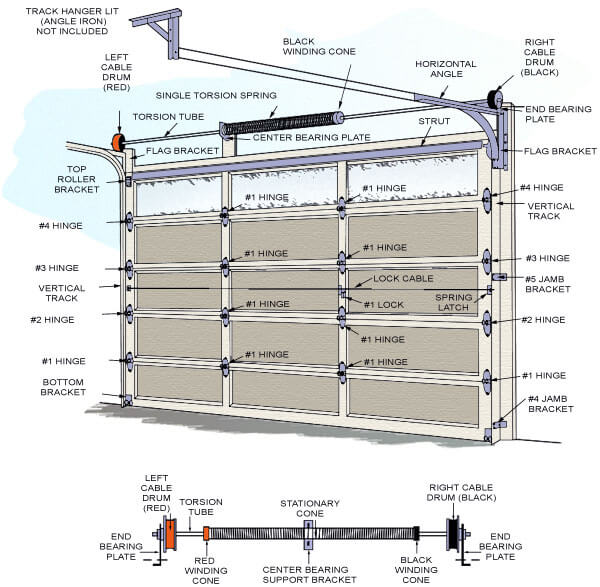
Your garage door works on either a torsion spring lift system or an extension spring lift system. Torsion springs are the most common spring type used on most doors and can accommodate any size garage door. Extension springs are the type that stretch out on the sides of the door. They were typically used on light weight and smaller garage doors such as an 8 ft wide door. These springs work well, although the garage door will not operate quite as smoothly as with torsion springs. The reason is because each extension spring lifts independently causing the garage door to sometimes jostle during operation, and at times open and close slightly crooked.
The job of the spring is to counter-balance the weight of the door. Without the assistance of the springs the door will be very heavy and your garage door opener unit will not be able to operate properly as a result. Most steel two-car garage doors can weigh between 180 and 300 pounds. Most people do not realize just how heavy these doors are because of the counter-balance system at work. A wooden door can weigh much more, from 300 to as much as 500 pounds! A garage door that is allowed to free fall will hit the ground with deadly force. This is why the functionality and maintenance of you garage door needs to be kept up at all times. Garage doors are very dangerous, and only a knowledgeable technician should perform service on them!

The lift system for garage doors has been in place for nearly 100 years. It has allowed them to operate both smoothly and efficiently. Essentially your garage door is suspended by cables that are under the tension of the springs. When the springs are wound up, they are then fastened to the torsion tube by set screws. The cable drums are fastened to the tube, and the cables wind up into the drum as the door travels upward. The bottom of the torsion cables are connected to the bottom sides of the garage door, therefore providing the counter weight needed to wind the springs up to the proper tension. When everything is in place, the garage door should almost lift itself. Everything is tied together in one system. It all works together. That is why it is so important to replace broken or damaged parts when it happens. Avoiding repairs and continuing to use a broken garage door will inevitably lead to more and more of an expense in the long run.
